


The Torn Bible
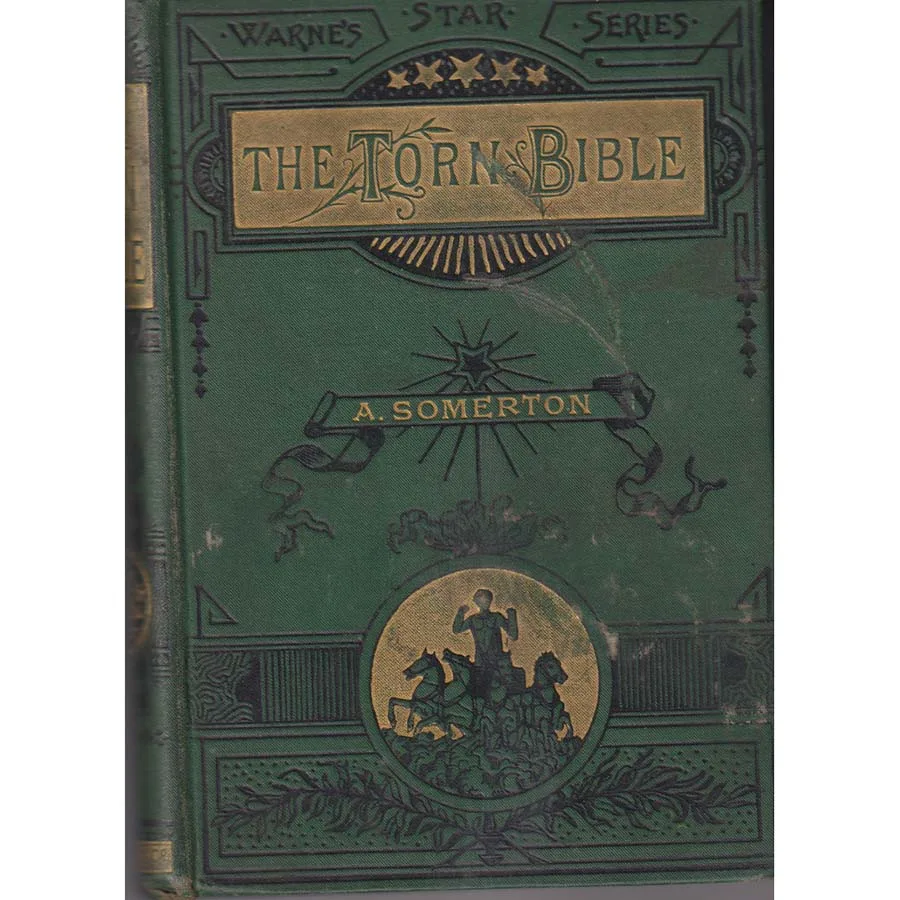
Publisher: Frederick Warne
Format: Hardback
ISBN: none
Behold: The Torn Bible (1903) by A. Somerton, published by Frederick Warne — a title that arrives already in a state of emotional emergency. You don’t call something The Torn Bible unless you’re planning to make the reader feel at least three of the following: concern, curiosity, moral tension, and the faint urge to sit up straighter and stop being sarcastic for a moment. (Don’t worry. We’ll manage.)
This is Edwardian-era earnestness in hardback form: a period when a book title could simply announce the central symbol and expect you to lean in respectfully. No spoiler-free coyness, no minimalist ambiguity, no “Untitled No. 7”. Just: Bible. Torn. We’re dealing with it. Somewhere inside, you can practically hear a narrator clearing their throat and saying, “Now then, there is a lesson to be learned…”
And that’s part of the charm. Because whatever The Torn Bible actually is — devotional story, moral tale, domestic drama with spiritual undertones, or a quietly devastating little narrative designed to be read aloud in a parlour — it’s very much from the era when fiction often came with a purpose. Entertainment was allowed, yes, but it was expected to behave itself.
Frederick Warne, of course, is a publisher with immaculate credentials: the sort of firm that makes you think of gilt titles, sensible typography, and books that have spent their lives on respectable shelves, flanked by other volumes that disapprove of modern music. So you’re getting that very particular early-1900s vibe: clean, clear, proper, and completely unembarrassed about notions like conscience, duty, and redemption.
Which means this book is a time capsule of values as much as it is a story. It’s the kind of thing that reminds you the Edwardians had their own anxieties, their own griefs, and their own ways of trying to make sense of the world — often by placing a charged object in the centre of the plot and letting it quietly do the work. A torn Bible is never just a torn Bible. It’s a metaphor with teeth.
Now, the delicious irony: this copy is in Good condition.
So despite the title promising ripped scriptures and possibly a household in moral tatters, the actual physical book has held itself together rather admirably. It’s a lovely little contradiction. The Torn Bible that isn’t torn. The Edwardian drama of damage and repair, presented in a form that has survived more than a century without falling apart in your hands. That’s either deeply satisfying or suspiciously on-theme, depending on your worldview.
As sold by Crappy Old Books, “Good” means it’s a solid, readable, presentable survivor — not a flawless museum relic, but certainly not something that looks like it was rescued from a damp hymnbook box behind a church boiler. Expect the usual gentle signs of age that come with 1903 paper and binding — the kind of patina that says “I have outlived several monarchs and I’m still here.” But overall: respectable, sturdy, and ready for another reader.
Who is this for?
-
Collectors of Edwardian moral fiction and domestic religious stories.
-
Fans of early 20th-century British publishing, especially Warne.
-
People who enjoy books that feel like they were written with a straight back and a firm handshake.
-
Anyone who appreciates a title that sounds like a crisis but arrives as a calm, tidy object.
If you want a book that will teach you something (or at least make you feel that you should be learning something), if you like your stories seasoned with conscience, and if you enjoy the odd thrill of handling a 1903 volume that’s made it this far without giving up, then The Torn Bible is a wonderfully sincere, quietly dramatic little piece of the past.
A torn Bible, un-torn book.
Edwardian symbolism, intact binding.
Crappy Old Books, as ever, providing the contradictions you didn’t know you needed.
Keep browsing: See more Fiction books Other books by A Somerton
